47 / Nov 9 – Nov 15, 2026 · 34 RELEASES
AI News Week 47, 2026
Agents, Robots and Inference. Anthropic's Claude Fable 5.2 became available on Amazon Bedrock and Claude Platform on AWS, alongside the restricted Claude Mythos 5.2, and Meta Superintelligence Labs released Muse Ember, priced at 10 cents per million input tokens. NVIDIA introduced GR00T 2, a world action model that reports 71% average success across 50 tasks with one demonstration per task and 95% with five, together with Isaac Lab 3.0. NVIDIA also published Nemotron 3.5 Super VL, with 120B total parameters and 12B active, on Amazon SageMaker JumpStart, and Dynamo recipes for four Korean open models that it says deliver up to 2x performance. Google added the eighth-generation TPU 8tx and TPU 8i Max, and is open-sourcing an XLA Serving Engine, TPU Sync and TorchTPU. Among the research and open-source releases, Tencent published DSpine for Qwen3.8-27B under Apache 2.0, and Baidu reported results from ERNIE Evolve without releasing the system itself.
Language Models (3)
qwenFS
vixhal-baraiya (GitHub) · Filesystem-in-Weights LLM
qwenFS is an experimental build of Qwen3.5-2B in which a filesystem is compiled into the weights as 8 extra transformer layers placed before Qwen's 24. The model handles its own write, read, link and search tool calls with no external tool server. On Apple silicon, forced tokens matched the circuit's reference exactly across scripted sessions of up to 128 files, and Qwen's text predictions were unchanged at all 139 positions checked. In a 57-turn scenario eval, adding the system-prompt doc raised passed turns from 49 to 57. The page text does not state a licence.
Open the source ↗
Claude Fable 5.2
Anthropic (announced via AWS Machine Learning blog) · Frontier Coding Model
Anthropic's Claude Fable 5.2, described as its most capable generally available model for technical work, is now available on Amazon Bedrock and Claude Platform on AWS, alongside Claude Mythos 5.2, which is restricted to Anthropic's verification programmes for cyber security and life sciences work. Anthropic positions Fable 5.2 for agentic coding across multi-repository codebases, long-running multi-day agents, scientific research and financial analysis. The page also covers a claude-api skill for Claude Code that helps migrate code to Fable 5.2; the skill is open source at anthropics/skills on GitHub. Fable 5.2 is a Covered Model with default data retention of up to 30 days and human safety review.
Open the source ↗
Muse Ember
Meta Superintelligence Labs · Lightweight agent model
Meta has released Muse Ember, the lightest and most cost-efficient model in its Muse family, designed for agent tasks such as tool calls, coding subtasks, routing, extraction and long document parsing. Meta cites Artificial Analysis's composite benchmark to position it as cheaper and smarter than Anthropic's Haiku and OpenAI's Luna, and prices it at 10 cents per million input tokens. Ember accepts text, images and audio, and is intended to pair with the larger Muse Wonder model in an agentic harness. The page does not state licensing or availability terms.
Open the source ↗
Vision & Image (2)
NVIDIA Nemotron 3.5 Super VL
NVIDIA, via Amazon Web Services · Agentic VLM
NVIDIA Nemotron 3.5 Super VL is a vision-language model that accepts images, video and text and outputs text. It has 120B total parameters with 12B active, a hybrid Mamba-2 and MoE backbone, a C-RADIO vision encoder and a 1 million token context. It is available in NVFP4 and BF16 variants on Amazon SageMaker JumpStart under the OpenMDW Licence Agreement 1.1. Reported results include 68.34 on OCRBench v2 (EN) and 52.30 on OSWorld-Verified for NVFP4, which is within about one point of BF16 on most benchmarks.
Open the source ↗
ComfyUI-PhotoDeblur
porfeng (GitHub) · Photo Deblur Nodes
A ComfyUI custom node package that adds HI-Diff and MISCFilter photo deblurring to ComfyUI, aimed at camera shake and motion blur. It supports original-resolution tiled processing with overlap blending, optional test-time augmentation, and a download node that fetches the official weights (RealBlur-J, RealBlur-R and GoPro variants) with SHA256 verification. The README shows before-and-after examples but gives no quantitative benchmark results, and the licence is not stated on the page.
Open the source ↗
Audio & Speech (1)

Confucius4-R2T2
Netease Youdao (Daniel Huang et al.) · Stable-Prefix Streaming ASR
Confucius4-R2T2 is a streaming speech recognition model that never revises its earlier output, built by post-training Qwen3-ASR-1.7B on 1,500 hours of Chinese and English audio with the audio encoder and projector frozen. It introduces the Longest Stable Prefix concept, which the authors prove is monotone and consistent with full-audio output, so no architectural change is needed. The authors report streaming quality close to the base model's full-context accuracy with stable text and low emission lag, and state that the model weights and code are open-sourced on Hugging Face and GitHub.
Open the source ↗
3D & Spatial (1)

SplatAnything: Gaussian Spacing Normalization for Feed-forward 3DGS across Arbitrary Scenes
Hao Yu, Zhenwei Wang, Yongzhen Hu, Yuning Gong, Junta Wu, Xiaowei Zhou, Hujun Bao, Tengfei Wang (Zhejiang University) · Gaussian spacing normalisation
SplatAnything addresses a limitation in feed-forward 3D Gaussian Splatting, where Gaussian spacing varies across scene scales and camera setups. It introduces Gaussian Spacing Normalization (GSNorm), which canonicalises a robust scene-level spacing statistic to give more consistent supervision for Gaussian prediction. The authors also build a benchmark spanning diverse datasets, input sparsity levels and extrapolated viewpoints, and report state-of-the-art results with the largest gains under large scene-scale and viewpoint variation.
Open the source ↗
Agents & Automation (11)

Open-HumanScale
Juncheng Ma et al. (DAGroup-PKU) · Human-video robot pretraining
Open-HumanScale is an open recipe for scaling egocentric human video pretraining to 50,000 hours, built around the Open-HumanScale-50K corpus, which is annotated with hand motion and natural language. The authors report a log-linear scaling law between pretraining hours and downstream robot success, and their HumanWAM-Vanilla model reaches 92.08% on RoboTwin 2.0 Clean2Clean. The HumanWAM-Goal variant, which adds joint human-robot pretraining, reaches 92.70% and 84.60% on the Clean2Clean and Clean2Random splits. The corpus, curation and pretraining pipelines, checkpoints, inference code and simulation evaluation suites are stated to be open-sourced.
Open the source ↗
agent-screenplay
gmpetrov (GitHub) · Agent Screen Recorder
Screenplay is an MCP server and agent skill for Claude Code, Codex, Cursor and other MCP clients. An agent explores a website or desktop app, writes a short JSON scenario, and Screenplay films it in a browser and edits the result with smooth cursor movement, automatic zooms, captions and optional voice-over. The tool itself contains no AI and needs no model key, as the agent supplies the reasoning. It is MIT licensed and installed via npx agent-screenplay init.
Open the source ↗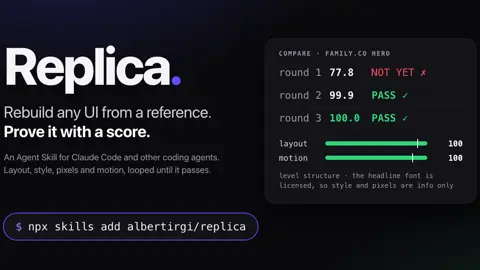
Replica
albertirgi (GitHub) · UI Clone Scorer
Replica is an Agent Skill for Claude Code and other coding agents that rebuilds a UI from a live site, local page, screenshot or screen recording. It captures a blueprint of the reference, then scores the rebuild on layout, style, pixels and motion, and the agent iterates until the score passes its level gate (structure, faithful or exact). Installable via the skills CLI, requires Node 20+ and Playwright's Chromium, and needs no API keys. The page does not state a licence.
Open the source ↗
numbrone
Steven Michael Thomas (community project built on herdr) · Agent Orchestration
numbrone is a community-built skill and bash script that acts as a chief of staff for coding agents. A chief agent takes plain-language requests, routes them to per-project manager agents, and those managers spawn parallel worker agents, each in its own git worktree and herdr tab. It works with Claude Code by default and other supported agents such as Codex and Gemini, and its state is kept in plain text files. The project states it is independent and not affiliated with the herdr team.
Open the source ↗
pwner
0x45dd (GitHub) · Pentest Agent
pwner is an LLM-driven agent that plans and runs authorised network penetration tests from the terminal, wrapping standard tools such as nmap, nuclei and impacket. It enforces target scope and requires explicit operator consent for intrusive actions in code, not via the prompt. It works with OpenAI, Anthropic, Google, DeepSeek or local OpenAI-compatible endpoints, or with `--no-ai` for a deterministic pipeline. Licensed AGPL-3.0-or-later, installable from PyPI, with 785 tests reported.
Open the source ↗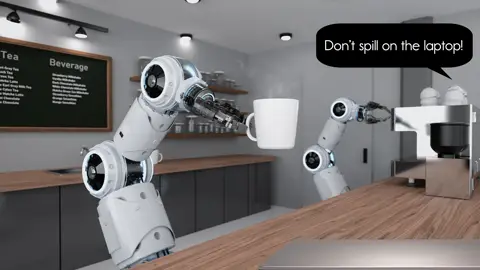
FLEX
MIT and New York University researchers (led by Andreea Bobu, MIT) · LLM Robot Planning
Researchers from MIT and NYU introduce FLEX, a feature-editing pipeline that lets people instruct a robot in conversational language, and the robot infers the broader intent behind them. Its Generalise step uses GPT-4o to extend a user's specified avoidance features to related objects, such as a phone near a laptop. The team demonstrated FLEX in simulated scenarios, including serving a cup of coffee, and the study is to be presented at the Conference on Robot Learning. The page does not state a licence or code release.
Open the source ↗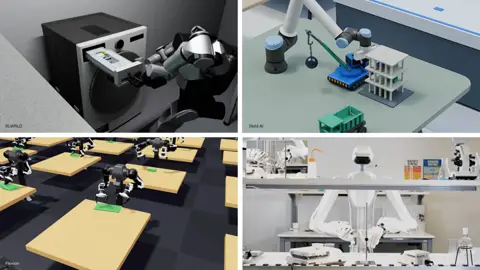
GR00T 2
NVIDIA · Open World Action Model
NVIDIA is introducing GR00T 2 at CoRL, described as an open frontier world action model built on NVIDIA Cosmos and trained on robot and human data, including 100,000 hours of open egocentric human data. The page reports 71% average success across 50 tasks with one demonstration per task, rising to 95% with five, and says the model ranks in the top three on several VLA and world action model benchmarks. The release is accompanied by Isaac Lab 3.0, which adds agent-assisted environment setup and a reinforcement post-training library for models such as GR00T.
Open the source ↗
Toward the Era of Agentic Embodied Intelligence
Chao Liang, Ke Chen, Fengxiaoxiao Li, Shibo Huang, Yufeng Sun, Zhaokai Yin, Jianhuan Lai, Haozhe Feng (AutoLab) · Agentic Robot Control
Introduces A2-MEAS, an embodied multi-agent framework that uses learned correction codes to adapt robot policies, and A2-WLA, a vision-language-action policy with motion-aware history and a latent world model. Reports 0.6411 Q-score and 45.40% task success on all 100 BEHAVIOR 2026 public tasks, 93.98% average success on RoboTwin 2.0, and 57.92% versus 26.67% for pi0.5 across 12 real-robot tasks. The authors say they will release the system, models, training scripts and infrastructure.
Open the source ↗ERNIE Evolve
Baidu · Automated Research Agent
ERNIE Evolve is an automated research system from Baidu that picks research directions, edits training and inference code, and runs experiments against a fixed, hidden evaluator. Baidu reports it beat the best public result on 3 of 4 public metrics, including a NanoChat validation BPB of 0.8763 and a NanoGPT Speedrun Track 1 time of 38.9 s on 8×H100. On ERNIE-5.5-Flash, it reports +33.7% deterministic inference throughput and +14.9% decode speed. The system itself is not released; only results and logs are on GitHub.
Open the source ↗
BookLeme (读了么)
bookleme (GitHub) · Book-to-Skill Compiler
BookLeme is an MIT-licensed, zero-dependency Python toolchain that compiles a book into an installable Agent Skill, either as a structured knowledge pack or as a runnable behaviour skill. It uses pluggable genre plugins and checks every quoted passage against the source text. On one real 273-page Chinese book, the repo reports 1.00 citation resolution and 0.00 verbatim violation, with the LLM-judged groundedness metric not yet connected.
Open the source ↗
PCBRouteAgent
Yue Zhang, Jilei Sun, Liqiang Jing, Yijie Wei, Ruohan Yang · PCB Routing Agent
PCBRouteAgent is a multimodal agent for printed circuit board routing. A Global Routing Planner uses board images and structured electrical and geometric data to set connection topology, routing order and layer transitions, while a Detailed Routing Executor carries these out through KiCad's native router with bounded local recovery. On 247 synthetic and real-world boards from PCBWorld-Bench, it reports clean-pass rates of 100%, 94.9%, 100% and 40% on the D2, D3-A, D3-B and D3-C splits, and beats the best baseline by 13.9, 36 and 10 percentage points on the three real-world subsets. No licence or code availability is stated.
Open the source ↗
Developer Tools (6)

NVIDIA Dynamo Recipes for Korean Open Models
NVIDIA · Dynamo Deployment Recipes
NVIDIA is releasing Dynamo-optimised deployment recipes for four Korean open models: A.X K2 (SK Telecom), K-EXAONE 2.0 (LG AI Research), Solar Open 2 (Upstage) and Motif-3 (Motif Technologies). Dynamo is an open-source distributed inference-serving framework for multi-node, data-centre deployments. The recipes are optimised for NVIDIA B200 GPUs and are stated to deliver up to 2x performance out of the box.
Open the source ↗
TPU 8tx and TPU 8i Max
Google · TPU Agent Infrastructure
Google has added two eighth-generation TPU systems: TPU 8tx, for confidential AI inference on sensitive data, and TPU 8i Max, which pairs two TPU 8i chips for large context windows and multi-agent workloads. Google says TPU 8tx offers up to 2x lower latency than TPU 8t, and that TPU Sync cuts key-value cache transfer latency and time to first token by more than 90%. Alongside the hardware, Google is open-sourcing an XLA Serving Engine, a TPU agent suite (in preview), TPU Sync, and TorchTPU, which runs PyTorch and Hugging Face models on TPUs.
Open the source ↗
WorldFoundry
OpenEnvision (Juanxi Tian, Jiadong Hou, Baiang Li, Xin Lin, Zhengbo Jiao, Weijia Zhang, Yeying Jin, Truong Nguyen) · World model infrastructure
WorldFoundry is open-source infrastructure for running and evaluating generative world models across video, 3D and 4D, embodied action, and interactive systems. It unifies model and benchmark discovery, runtime setup, execution orchestration, artefact management and visualisation, with modality-specific adapters that keep each system's native inputs and evaluation protocols. The catalogue lists 270 model entries, 74 benchmarks and 62 registered metrics, with readiness and execution evidence recorded separately. The paper also proposes a framework for what a generative world model should do: maintain persistent state, respond to interventions and produce causally consistent trajectories.
Open the source ↗
DSpine for Qwen3.8-27B
Tencent · Speculative decoding draft
DSpine is a five-layer, block-size-16 draft model for speculative decoding with Qwen3.8-27B, released by Tencent under Apache 2.0 and designed to run on SGLang. On GSM8K at greedy decoding it reaches an acceptance length of 7.20, against 5.69 for the official DFlash2 draft model. On agent workloads it reports end-to-end throughput of up to 3.84× over autoregressive decoding (WorkBuddy Office, low reasoning), and the page lists the SGLang launch flags needed to use it.
Open the source ↗
Amazon Bedrock Managed Knowledge Base: single-shot and agentic retrieval
Amazon Web Services · Retrieval modes
Amazon Bedrock Managed Knowledge Base now supports single-shot RAG and retrieval-only requests through the AgenticRetrieveStream API. The maxAgentIteration parameter, now in the range 0 to 5, selects one of three modes: passages only with no foundation model calls (0), one retrieval then one generated answer (1), or agentic multi-step planning and search (2 to 5). Setting generateResponse=true with a value of 0 returns a 4xx error, as generation needs an LLM call.
Open the source ↗Aspen
Reason Machines · Agent Git Server
Aspen is an open-source, self-hostable Git server written as a single Rust binary, built for repositories that many AI agents push to at once. It scales writes per branch rather than per repository, stores branch history in PostgreSQL or SQLite and packs in S3-compatible object storage, and works with stock Git over HTTPS and SSH. Self-reported results on one 8-core server show 567 pushes per second sustained for five minutes, with 314 ms p99 push latency, but the project is pre-alpha and the 24-hour durability gate is not yet met. It is licensed under Apache 2.0 and described as an independent implementation of the design OpenAI described for Pando.
Open the source ↗
Research & Safety (10)

WebsiteBench
TIGER-AI-Lab · Web Agent Benchmark
WebsiteBench is a benchmark in which agents must reverse-engineer a full-stack version of a production website they can only explore through a browser, matching its appearance and behaviour. It contains 70 websites and 46,916 hidden test cases, scored by the share of cases passing functional checks and a normalised SSIM of 0.99 on visual checkpoints. Code and verifier are Apache-2.0, installable via PyPI and run with the Harbor framework; the reference websites are for non-commercial research only.
Open the source ↗
WorldParticle
MIT, University of British Columbia and collaborators (incl. Meta) · Unified Physics Simulator
WorldParticle is a deep-learning system that simulates many kinds of matter, from sand and fluids to protein folding, within one architecture. It represents materials as particles and uses a neural network to predict their positions and properties one step at a time, learning the dynamics rather than relying on hand-coded equations. The authors say it generalises to materials, forces and environments unseen in training, and the work is described in an open-access paper to be presented at SIGGRAPH Asia.
Open the source ↗
LowRAM: Low-Rank Keys and Amortised Values for Composable KV Cache Compression at Test-Time
Teresa Delgado, Hugo Hazard, Martin Benfeghoul, Jun Wang, Zafeirios Fountas · KV Cache Compression
LowRAM is a KV cache compression method for autoregressive decoding that pairs test-time value cache amortisation with cross-layer low-rank key compression. The authors report 4x near-lossless value compression, up to 5x higher peak decode throughput at 4x compression, and 26.9x compression at 94.5% of baseline performance on long contexts when combined with quantisation and eviction. Results are reported across three model families.
Open the source ↗
FinDendro: Benchmarking Temporal Self-Knowledge for Financial Backtesting
Lingfei Qian, Yan Wang, Xueqing Peng, Yupeng Cao, Yuechen Jiang, Zhuohan Xie, Anke Xu, Wenbo Cao (The Fin AI) · Temporal Knowledge Benchmark
FinDendro is a benchmark of 2,226 dated U.S. facts from 1999 to 2026, covering monthly macroeconomic series, month-end stock prices and Federal Reserve decisions. It tests whether LLMs' self-reported knowledge cutoffs can be trusted for leak-free backtests. The authors report that GPT-5 answers 76% of controlled facts correctly but claims to know only 38%, and that knowledge claims can persist up to seven quarters beyond the measured knowledge boundary. They provide a procedure for choosing backtest periods based on demonstrated factual knowledge.
Open the source ↗
HOPE: Higher-Order Pruning of Experts
Amazon (Alex M Tseng, Luca Zancato), via Hugging Face blog · MoE Expert Pruning
HOPE is a second-order method for pruning experts in Mixture-of-Experts language models. Unlike first-order methods that score each expert independently, it accounts for pairwise interactions between co-activated experts when choosing which to remove. The authors report that at 50% pruning HOPE achieves the best average rank of any method tested, with gains of up to +6.1% on agentic coding tasks over the next-best pruning method. The post links to a paper with the full derivation; licence and code availability are not stated on the page.
Open the source ↗0
0sec Labs · AI Security Harness
0sec Labs has open-sourced 0, a software harness that wraps LLMs and security tools to run vulnerability investigations, code review, pentesting, reverse engineering and fix generation against authorised targets. It is released under MIT OR Apache-2.0 as a research preview, with a local browser console, a headless CLI and an MCP server, and works with 14 listed model providers. The team reports 93/95 (97.9%) on XBOW web CTFs and 36/40 on Cybench, but these scores are self-reported and not pass@1.
Open the source ↗
P^2-MOPD: Accelerating Multi-Teacher On-Policy Distillation via Parameter Priors
StepFun (Sinuo Wang et al.) · Parameter-prior distillation
P^2-MOPD treats a linear combination of student and expert parameters as one differentiable model, and jointly optimises the mixing coefficients and the student weights under the on-policy distillation objective. Unlike task arithmetic, the student stays trainable, so the experts act as parameter priors. Across four domains at 1.7B and 4B scales, the 1.7B model reaches 94.7% average recovery versus 80.9% for MOPD, and surpasses MOPD's final average recovery in half the training steps.
Open the source ↗
OneTrans-GSR: A Generative Slate Ranking Paradigm Unifying Reranking and Mix-Ranking with One Autoregressive Transformer
ByteDance (Feng Cheng et al.) · Generative Slate Ranking
OneTrans-GSR is a decoder-only policy that extends ByteDance's deployed OneTrans backbone to generate full exposure slates end-to-end, replacing hand-crafted rules in reranking and mix-ranking. A reward model scores complete slates and guides reinforcement learning toward slate-level and long-term objectives. In online A/B tests it improved GMV per user by 2.63%, advertiser value by 2.06% and repurchase rate by 2.03%, while cutting end-to-end latency across both stages by 13%.
Open the source ↗
LongBanana
Kolors Team, Kuaishou Technology (Haoxiang Cao et al.) · Image Synthesis Benchmark
LongBanana is an expert-designed and expert-verified benchmark for long-context multi-reference image synthesis, covering 90 tasks with about 32 reference images, 20 constraints and 4,670 atomic evaluation items in total. Evaluation uses an entity-relation graph and checklists for content fidelity, relational binding and global constraint satisfaction, with a 15% double-labelled subset showing 89.4% exact agreement and a 0.83 quadratic weighted kappa. The authors also introduce LongBanana-Gen, an agent-harness framework, where a ReAct-Plan-Exec-Reflect workflow gives harness-dependent gains over direct generation. Code and data are stated to be available at long-banana.com.
Open the source ↗
Nemotron-Personas-Finance-Japan
NVIDIA and Elith · Synthetic Persona Data
A synthetic persona dataset for financial AI in Japan, released by Elith and NVIDIA as an extension of Nemotron-Personas-Japan. It contains 1M records of 9 personas each (9M personas, about 1.5B tokens), built from official Japanese demographic and labour statistics using NeMo SDG-PGMs and NeMo Data Designer, with input from several Japanese financial institutions. It is released under CC BY 4.0 for commercial and non-commercial use.
Open the source ↗
Published by Quanta AI Labs, an AI agency in India. Browse every week in AI News Weekly.