46 / Nov 2 – Nov 8, 2026 · 25 RELEASES
AI News Week 46, 2026
Cyber, Video and Open Weights. OpenAI introduced GPT-6 Cyber, a cybersecurity model for finding exploitable vulnerabilities and developing fixes that is trained to stay within authorised scope, though the page gives no benchmarks or availability details. OpenAI also released Images 2.6 across ChatGPT, Codex and the API, and Google DeepMind released Gemini Omni 1.2 Flash, which makes clips up to 15 seconds long at $0.07 per second for 720p, 30% lower than Omni 1.1. Baidu published the raw ERNIE 5.5 Flash Base checkpoint, a 280B-parameter Mixture-of-Experts model with 14B active parameters, under a licence that excludes the EU, UK and South Korea. Microsoft's Mage Team released Mage-VL-Cowork, a 4B model that reports 66.0% on OSWorld-Verified under Apache-2.0, and NVIDIA added four Cosmos 3 Nano checkpoints for interactive world simulation.
Language Models (2)
ERNIE 5.5 Flash Base
Baidu · MoE Base Model
Baidu has released ERNIE 5.5 Flash Base, a raw pre-training checkpoint of a sparse 280B-parameter Mixture-of-Experts text model that activates 14B parameters per token. The weights stop at the end of pre-training, with no mid- or post-training applied, and it supports a 128K training context and 1M context for inference. Baidu reports the best score on 24 of 30 base-model benchmarks in its own pipeline, including MMLU-Pro at 78.4 against 69.2 for DeepSeek-V4-Flash-Base (self-reported). Weights are available in FP8 and BF16 on Hugging Face and ModelScope under the ERNIE 5.5 Flash Base License v1.0, which excludes the EU, UK and South Korea.
Open the source ↗
Ripple-65B Preview
Ricursive Intelligence · Dense Agentic Coder
Ripple-65B Preview is a 65B-parameter dense Transformer pretrained on 12 trillion tokens, with support for up to 1,048,576 tokens of context. The lab reports 80.5 on Terminal-Bench 2.1 (self-reported), which it presents as ahead of several larger US open-weight models, with a focus on agentic coding. The repository holds the BF16 instruction-tuned model; an NVFP4 checkpoint and a BF16 base model are also provided, under Apache 2.0.
Open the source ↗
Vision & Image (2)
Images 2.6
OpenAI · Image Generation Model
OpenAI has released Images 2.6, which adds faster image generation, GIF creation and more precise editing. It also brings new API controls, and the update is available across ChatGPT, Codex and the API.
Open the source ↗
P-H3-Image
Pruna AI (based on MiniMax-H3) · 8-Step 8MP Image
P-H3-Image is a text-to-image and image-editing model from Pruna AI, built on MiniMax-H3 and distributed as a diffusers pipeline. It renders 8-megapixel images in 8 steps without classifier-free guidance, and edits or composes using up to 8 input images. It includes a prompt upsampler based on Qwen3.5-9B that is on by default. The weights are 33.1B parameters in the transformer and about 101 GB in bf16, and the page lists the MiniMax-H3 community licence.
Open the source ↗
Video & Animation (3)
Gemini Omni 1.2 Flash
Google DeepMind · Video Generation Model
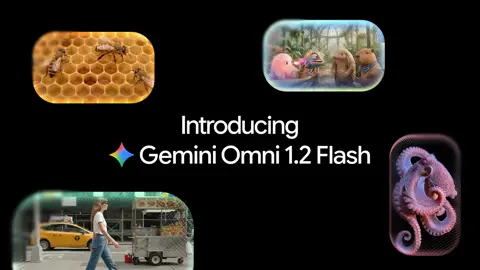
Google DeepMind has released Gemini Omni 1.2 Flash, a video generation and editing model that creates native clips up to 15 seconds long, up from 10 seconds in Omni 1.1, with multi-turn conversational editing and improved reference adherence. The price is 30% lower than Omni 1.1, at $0.07 per second for 720p video, and the model is generally available on the Gemini API and Google Cloud. Outputs carry an imperceptible SynthID watermark.
Open the source ↗
NVIDIA Cosmos 3 Nano interactive world simulation checkpoints
NVIDIA · World Model Checkpoints
NVIDIA adds four open-weight post-trained checkpoints to its Cosmos 3 Nano family for interactive world simulation and multi-sensor driving scenes. Cosmos3-Nano-Transfer-Auto generates synchronised multi-view driving video across up to 11 cameras, with joint RGB and LiDAR generation, and Cosmos3-Nano-Sim-Auto is its causally distilled streaming variant. Sim-Transfer renders RGB from simulator controls, and Sim-Bimanual predicts video from bimanual robot actions. Each model has 16B trainable parameters and is released under OpenMDW 1.1, which permits commercial and non-commercial use.
Open the source ↗
Pika-H3-Flex
Pika Labs · Video LoRA Adapter
Pika Labs has released Pika-H3-Flex, a LoRA adapter built on the MiniMax-H3 base model for image-to-video and audio-video generation, listed for use with diffusers. The model card's examples cover multi-shot camera direction, synchronised sound and music, and motion-controlled scenes from a reference image. The page gives no benchmark figures. It is released under the MiniMax H3 Community Licence Agreement, which is listed as 'other'.
Open the source ↗
Audio & Speech (1)

Phonon TTS
Gradium (Olesia Krizhevich, Laurent Mazare, Eric Bezzam, Eustache Le Bihan) · On-Device TTS
Gradium has released Phonon, a small text-to-speech model that runs fully on-device without a server or network connection. Two sizes are available, about 65 MB and 75 MB, covering English, French, German, Spanish and Portuguese, with more than 100 built-in voices and support for voice cloning and voice design. On the Hugging Face Open TTS Leaderboard, it ranks first in German and Spanish for intelligibility, in the top three in every language evaluated, and tops the CPU streaming benchmark for time-to-first audio. Phonon 31m (English) is Apache 2.0, while the other models are CC BY-NC, and the model is also available in Transformers from v5.21.
Open the source ↗
Agents & Automation (5)
GPT-6 Cyber
OpenAI · Security Agent Model
OpenAI has introduced GPT-6 Cyber, a cybersecurity model for finding exploitable vulnerabilities and developing fixes. According to the page, it is trained to stay within authorised scope; the page gives no benchmarks or availability details.
Open the source ↗
Mage-VL-Cowork
Microsoft Mage Team · Hybrid CUA Agent
Mage-VL-Cowork is a 4B vision-language policy that combines GUI interaction and bash-based code execution in a single model, without an external orchestrator. Microsoft reports 66.0% on OSWorld-Verified under a 50-step budget, which it describes as the best result among 4B models. The model is built from the Mage-VL checkpoint through a five-stage training curriculum and is released under Apache-2.0.
Open the source ↗
PyRUA-DataFarm
Kewei Zhang et al. (DAGroup-PKU) · Agent Data Farm
PyRUA-DataFarm uses a coding agent to replace teleoperators for collecting robot demonstrations. From one calibration episode, the agent builds a simulated scene, an expert controller and a success judge, and a video model renders the rollouts as photorealistic multi-view video labelled with actions. On five real-robot tasks, policies trained only on farm data achieved 93 successes in 100 trials against 84 for policies trained on teleoperated data, and kept 87 successes under an unseen tablecloth and lighting where teleoperation-trained policies fell to 46.
Open the source ↗Cheminformatics Skills for Google Antigravity
Google DeepMind · Chemistry Agent Skills
Google DeepMind has released Cheminformatics Skills for Google Antigravity, which let an agent handle chemistry data wrangling, literature mining, matched molecular pair analysis and property modelling. The language model orchestrates workflows and reasoning, while deterministic tools such as RDKit perform the molecular calculations, with connectors to ChEMBL and PubChem. In a lung cancer example, the page says the agent searched thousands of compounds and proposed novel rigidified macrocycles with synthetic routes in about an hour. Licence and availability details are not stated on the page.
Open the source ↗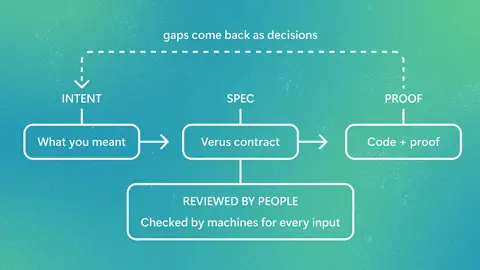
PDD Kit
Microsoft Research (with GitHub Next) · Formal Verification
PDD Kit is a toolkit for Proof-Driven Development, which turns a developer's intent into a formal specification in Verus and proves that agent-written Rust code meets it for every input, falling back to tests where a proof cannot reach. In a full-stack Pet Store app built inside GitHub Next's Chopin, it formally verified the login logic, uncovered existing bugs and needed no line-by-line code review from the developer. The page does not state a licence or release availability.
Open the source ↗
Developer Tools (5)
FlashProve
Anthropic (Frontier Red Team) · Provable Inference
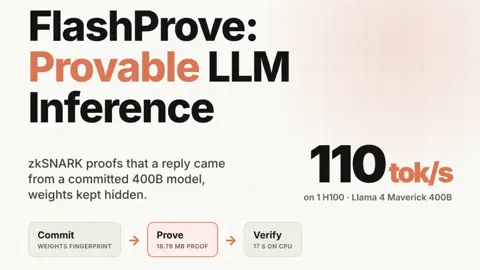
Anthropic's Frontier Red Team has released FlashProve, an open-source research prototype and zkSNARK system that lets a user verify a reply came from a committed model without revealing the weights. On Llama 4 Maverick (400B MoE, about 17B active), the page reports about 110 tokens/second proving on one H100, 18.78 MB proofs and 17-second CPU verification. Proving costs roughly 70 to 95 times the GPU time of plain vLLM inference, and context is capped at 1,024 tokens. The code is released under Apache 2.0.
Open the source ↗
CUDA Toolkit 13.5
NVIDIA · GPU Toolkit Release
NVIDIA's CUDA Toolkit 13.5 reaches general availability with production support for the Vera Rubin GPU architecture and extends Windows on Arm support to DGX Station. New features include Multi-Process Service v3 with weighted timeslicing and SM partition load balancing, multi-GPU communication and a public preview of SIMT interoperability in CUDA Tile, and cuda.core 1.2 with batched memory copies. CCCL 3.5 adds public tuning APIs for CUB and batched Top-K selection integrated into FlashInfer.
Open the source ↗
NVIDIA Attribution
NVIDIA · Failure Attribution
NVIDIA Attribution is an open-source, workload-centric failure diagnosis system that correlates logs, metrics, telemetry and scheduler state into a structured diagnosis with root cause, affected nodes, supporting symptoms and an evidence trail. It ships as an Attribution Service with a REST API and a Python Blueprint that connects Slurm, Kueue, Loki, Kubernetes pod logs and PromQL metrics. The post says it runs in production across NVIDIA AI infrastructure, analysing millions of workloads weekly across hundreds of thousands of GPUs, and uses deterministic rules so results are reproducible.
Open the source ↗
NVIDIA Recovery
NVIDIA · Training Recovery Service
NVIDIA Recovery is an open-source, workload-level service that detects interruptions in distributed training jobs from application logs, GPU metrics and scheduler signals, attributes failures, isolates implicated nodes and restarts workloads from checkpoints according to configured policy. It integrates with Slurm through a reference Advisor Controller deployable via Helm chart, and new deployments start in monitor mode so operators can check signal quality before enabling autonomous actions. In a production study on one training cluster from 9 July to 9 October, it covered nearly 200 jobs per day and recorded about 8,550 anomaly detections, with mean detection and recovery-action latencies of 69 and 94 seconds.
Open the source ↗
NVIDIA AI Cluster Runtime (AICR) Vera Rubin recipes
NVIDIA (Mark Chmarny, Yuan Chen) · Vera Rubin Recipes
NVIDIA describes AI Cluster Runtime (AICR), which captures tuned Kubernetes configurations as reusable recipes, generates deployment bundles and validates running clusters. A new Vera Rubin NVL72 recipe family, shipping as Preview, encodes validated driver, DRA driver v0.5.0, GPU Operator v26.7.0 and kernel settings. End-to-end validation reported a cross-node NCCL all-reduce of 744.71 GB/s bus bandwidth at 16 GiB over NVLink.
Open the source ↗
Research & Safety (7)

StateBench
Ai2 (Allen Institute for AI) · State-tracking benchmark
StateBench is a long-context benchmark that tests how well language models track changing entity state across long documents, at four difficulty levels from immutable assignment to assignment by reference. Ai2 reports that pretrained transformers handle the simplest level but stay at chance on general finite problems, while Gated DeltaNet and hybrid models trained directly on the task generalised almost perfectly on the easier levels out to 64,000 assignments. Four frontier models performed well on the easier levels but fell to 13% or lower accuracy on the longest general finite problems. A tech report, dataset and code are linked from the post; the licence is not stated.
Open the source ↗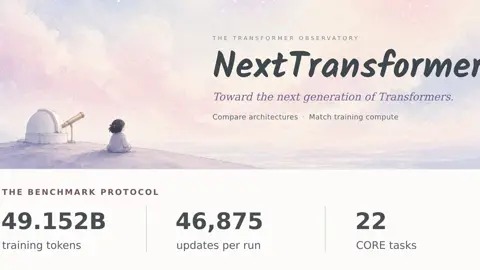
NextTransformer
Interactive-Active-AI · Architecture Benchmark
NextTransformer is an open-source framework and benchmark for comparing next-generation Transformer architectures, including recurrent depth, sparse and linear attention, residual-stream variants and hybrids. All models are trained on the same data for the same 49.152B tokens at matched theoretical training FLOPs per token, and evaluated at the same checkpoints. The release includes 31 finished runs, 36 model cards and the full protocol, and is available under the MIT licence. The page describes pretraining of a model with about 1.4B parameters taking 2–4 days on one 8-GPU node.
Open the source ↗
VFlash: Fast, Accurate Visual Planning via Flash Primitive Decoding
NVIDIA (Yu-Cheng Chou et al.) · Flash Visual Planning
VFlash is a decoding method for visual planning in vision-language models, predicting points, boxes and trajectories jointly in one forward pass with a lightweight drafter instead of one coordinate token at a time. Across evaluated 2D and 3D robot trajectory tasks it reduces prediction errors relative to autoregressive decoding. Preliminary single-rollout measurements show about 25x faster generation for 3D point motion forecasting. A world action model conditioned on VFlash plans reaches 70.2% average success across four MolmoSpaces task suites, against 62.6% for the baseline.
Open the source ↗
FrontierPhysics
BenchFlow (Bingran You, Wenjun Ke, Ria Rosenauer, Bo Liu, Wenbo Chen, Min Chen, Shuqi Xu, Yue Ma) · Physics Agent Benchmark
FrontierPhysics is an end-to-end benchmark of 56 physics research tasks written by 42 physicists from their own work, spanning nine domains. Agents must review literature, plan, run research and experiments, and produce a scientific manuscript, graded by deterministic verifiers and expert rubrics. Across 22 models in 26 configurations, no configuration passes more than 46 of its 168 rollouts, with frontier agents mainly weak in rigorous reasoning and expert intuition.
Open the source ↗A thousand fewer paths to root
OpenAI · Autonomous Vuln Patching
OpenAI describes an autonomous pipeline that found, validated and generated patches for 948 local privilege-escalation vulnerabilities in the Linux kernel. The page text is brief, so no details of the method, availability or licence are given.
Open the source ↗
AI-PPG-ACC-HTN
Google Research · Smartwatch hypertension AI
Google Research presents AI-PPG-ACC-HTN, a multimodal system that uses PPG and accelerometer signals from a consumer smartwatch to passively detect signs of hypertension without cuff calibration. It was pre-trained with self-supervised contrastive learning on 492,347 hours of unlabelled data from 2,109 participants, then validated in a prospective five-site US study of 196 participants against 24-hour ambulatory blood pressure monitoring. For initial screening it reported 65.8% sensitivity, 90.0% specificity and 80.6% PPV. The page does not state a licence or code release.
Open the source ↗
Agile Deliberation
Google Research (Otilia Stretcu, Leijie Wang) · Interactive Classifier Framework
Agile Deliberation is a framework for building image classifiers for subjective categories, such as "healthy food" or clickbait "pay-to-play" content. It guides users through concept scoping, where they define sub-categories and exclusions, then uses vision-language models to surface borderline images and an LLM-driven prompt optimisation loop to refine the classifier. In 18 live sessions of 1.5 hours each, the authors report higher-performing classifiers than zero-shot, automated-collaborator and manual baselines, with reduced user fatigue. The underlying code and algorithms are open-sourced on GitHub.
Open the source ↗
Published by Quanta AI Labs, an AI agency in India. Browse every week in AI News Weekly.